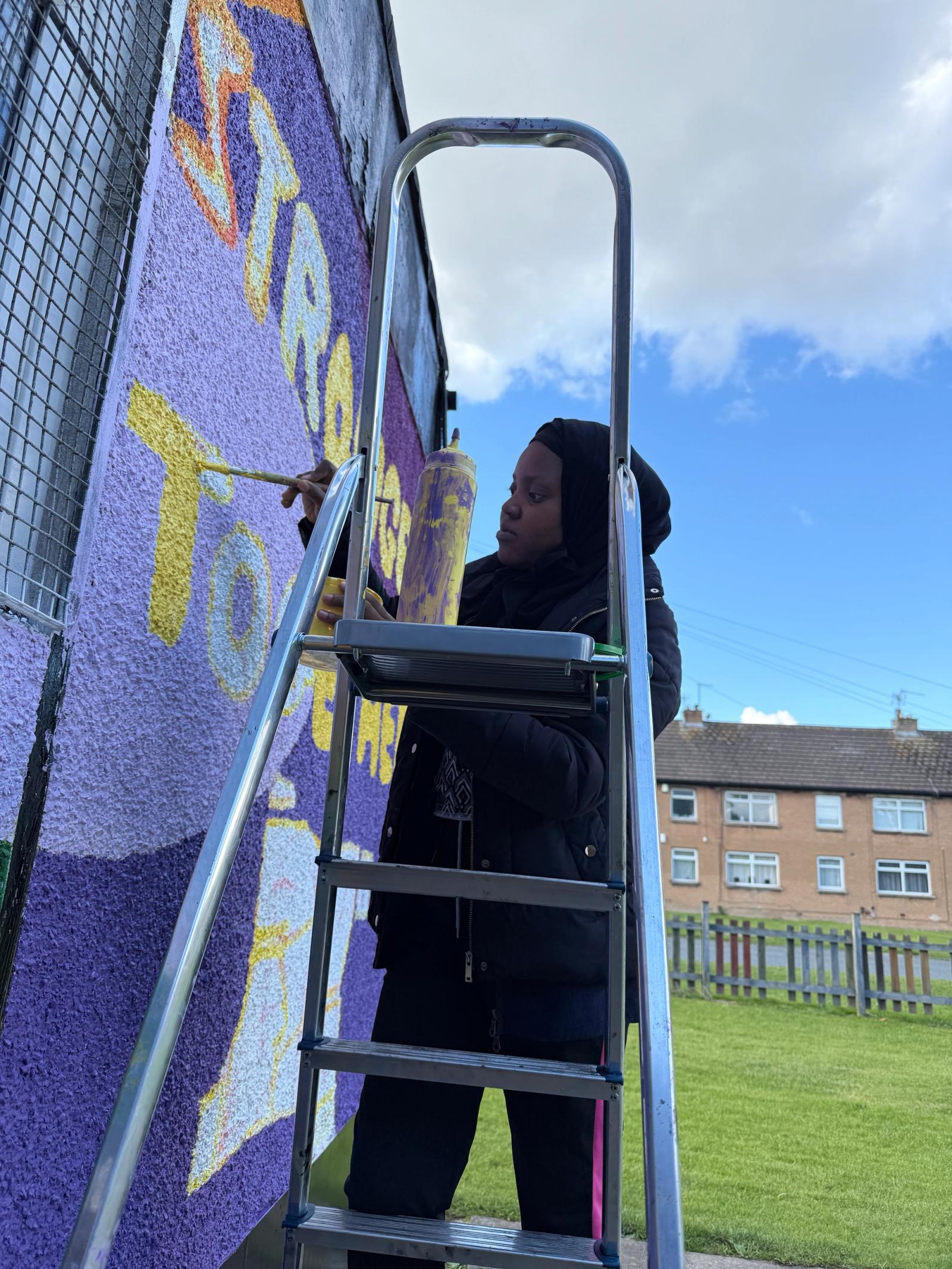
Working on a public mural changes my relationship with making.
In the studio, I can spend time alone with an idea. I can move something, cover it, return to it or decide that a work is not ready to be seen. A wall is different. It already belongs to a place before the first mark is made, and whatever is created there becomes part of the visual life of that space.
That brings a different kind of responsibility.
A public artwork does not enter an empty space. It enters somewhere that already holds people, memories and everyday life.
Working on Stronger Together made me think more carefully about this relationship between art and shared space.
The project moved my practice beyond the private encounter between artist and artwork. Making something intended to remain within a community meant thinking not only about colour and composition, but also about how people might encounter the work as part of their ordinary routines.
That experience connected with questions already present in my studio practice.
What makes somewhere feel like ours? How do relationships contribute to our sense of place? How can an image acknowledge connection without deciding in advance what everyone who sees it should feel?
These questions are closely related to the way I think about home and belonging.
Since moving to the United Kingdom, I have become increasingly interested in the difference between living somewhere and developing a relationship with that place. Belonging is not immediate. It develops through familiarity, participation, relationships and repeated encounters.
Public art has given me another way of thinking about that process.
Painting on a wall is physically different from working on canvas, but the deeper enquiry remains connected. Colour still carries emotion. Images still hold associations. What changes is the context. The work has to exist alongside architecture, weather, movement, conversation and the lives already unfolding around it.
Bradford has become part of that developing understanding for me. Through making, exhibiting and participating in creative projects here, I have begun to experience place not simply as somewhere I arrived, but as somewhere in which relationships and memories continue to form.
That does not replace other understandings of home. It adds another layer.
Perhaps that is what public practice has taught me most clearly. Belonging does not always begin with certainty. Sometimes it begins with participation: making something, sharing a space, meeting people and gradually becoming part of the memories a place holds.
A wall may not belong to me.
But for a period of time, making on it allows my practice to become part of something shared.


