There are some ideas I return to without deliberately deciding to return to them.
Growth is one of them.
I am interested in growth not only as becoming something new, but as a process shaped by what was already there. A flower does not appear independently of its roots. What becomes visible is connected to something beneath the surface, something that has been gathering, holding and sustaining it.
What we inherit does not have to remain unchanged in order to remain part of us.
This is one of the ways I think about cultural inheritance in my practice.
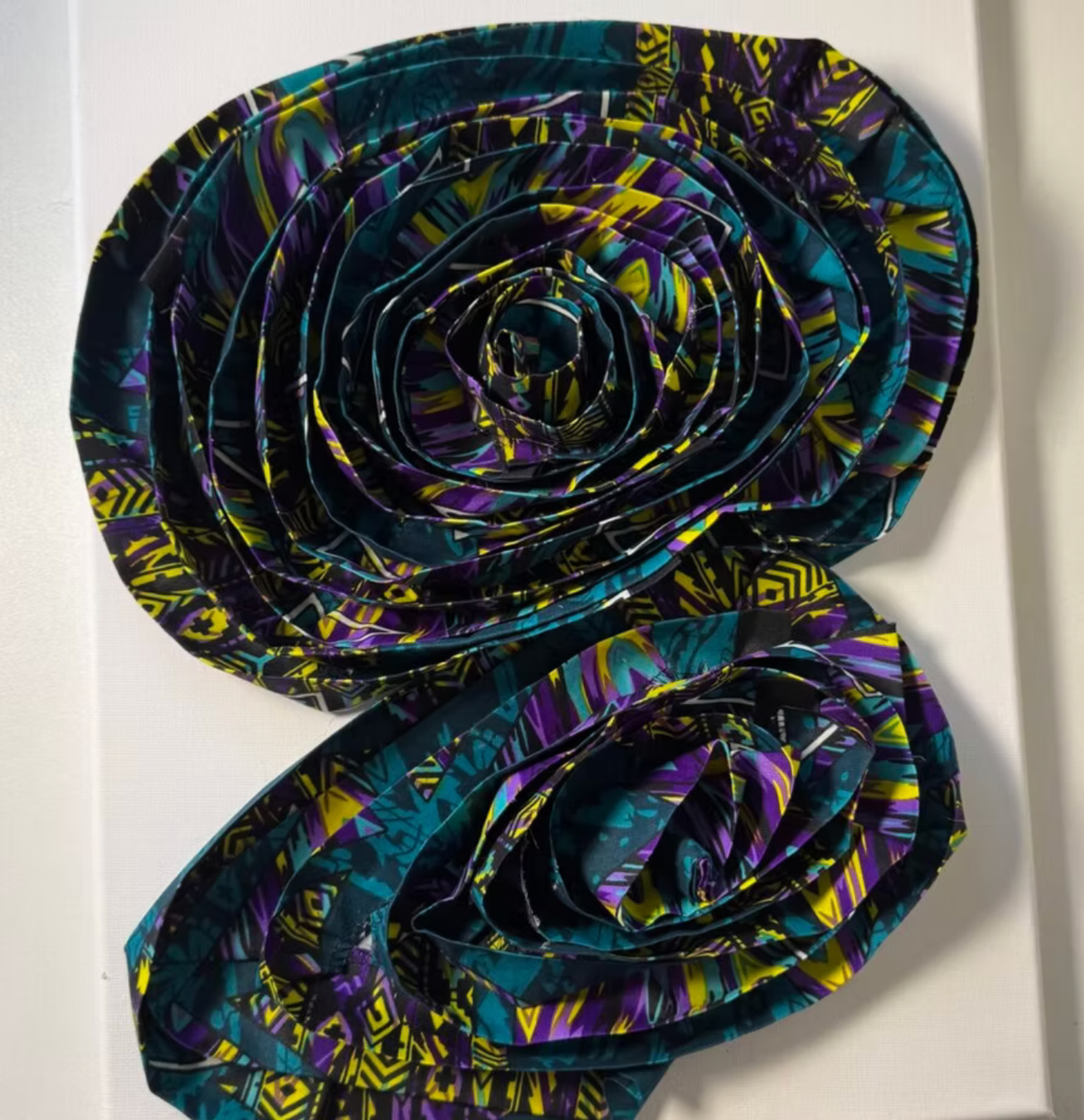
Pattern has become an important part of that thinking. African print and textile languages carry associations that extend beyond their immediate visual qualities. Colour, repetition and pattern can hold familiarity, cultural memory and connections that are difficult to describe entirely through words.
At the same time, I do not want inheritance to become something fixed.
What we receive changes as we do. We reinterpret it through different experiences, places and circumstances. Some things become more significant with distance. Others take on meanings we could not have understood when we first encountered them.
Blooming Between Worlds developed within these questions.
I was thinking about what it means to grow while remaining connected to what has shaped you. Growth can involve movement, adaptation and change without requiring everything that came before to disappear.
That idea has become increasingly important to me as my relationship with home has changed.
Home can be connected to a physical place, but it can also survive through memory, relationships, familiar visual languages and the things we continue to recognise as part of ourselves. Cultural inheritance works in a similar way. It can travel, adapt and enter new contexts without becoming meaningless.
Perhaps blooming is therefore not about becoming entirely new.
It can also be about allowing what has been carried quietly within us to take another form.


